Skip to content
Themba Tutors

START HERE

Smart Students. Inconsistent Performance.

Across New York City, many families begin searching for support when a capable student’s results stop matching their ability. Many parents notice that even smart students struggling in school can experience declining motivation, incomplete homework, and inconsistent academic performance despite strong potential.

Many smart kids, bright students, and even a highly capable bright child may experience bad grades or poor grades not because of intelligence, but because of underlying academic and executive functioning challenges. These children may include exceptional students whose performance does not consistently reflect their abilities. They often appear engaged in one class yet overwhelmed in another, creating confusion for families, teachers, and educators alike.

Students navigating demanding environments—from accelerated public school tracks to competitive private schools—often struggle not with intelligence, but with execution under pressure. Many students and kids possess strong reasoning ability, but difficulties with attention, organization, and working memory interfere with consistent performance and long-term school success.

Smart Students Struggling In NYC

Understanding How Students Learn and Perform

Families may also encounter concerns involving giftedness, dyslexia, ADHD, attention regulation, or other learning differences. A student can demonstrate advanced reasoning or strong academic potential while still requiring structured support to manage reading, organization, attention, or executive functioning demands.

The Problem Is Not Intelligence: Understanding Students’ Learning Challenges

Most academic inconsistency is caused by missing systems, not lack of ability.

Students in NYC schools are expected to manage complex workloads, long-term assignments, and exam-heavy grading structures. When systems are missing, performance becomes unpredictable.

A student may understand material one week and fall behind the next. This often creates significant frustration for both the child and their family.

Many smart children experience hidden academic weaknesses involving planning, task initiation, emotional regulation, or memory retention. These are among the most common reasons capable students struggle academically despite strong cognitive potential.

This is why traditional tutoring alone often fails to solve the problem.

Learning Systems That Improve Grades and School Success

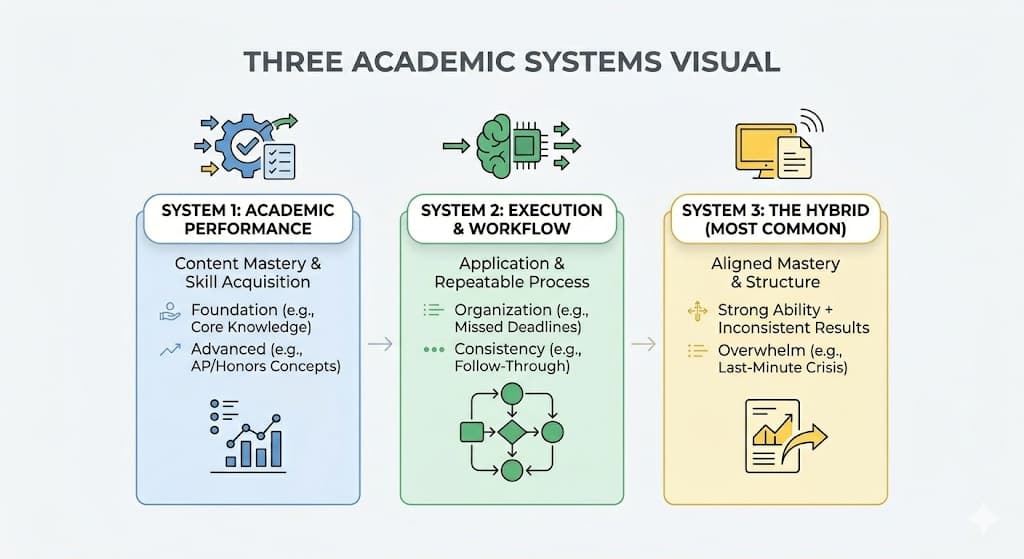
Three Types of Academic Systems
  • Academic Performance Systems for Learning and Reading Skills

    Academic performance systems focus on how students learn and master material.

    These systems are used when the issue is comprehension, retention, reading, or subject-specific difficulty. Academic specialists often evaluate how a student processes information, including verbal comprehension, processing speed, and other cognitive factors commonly measured through IQ tests.

    Common indicators include:

    • gaps in foundational knowledge
    • difficulty with AP or Honors-level concepts
    • inconsistent understanding across subjects
    • weak reading skills and test-taking performance
    • difficulty completing independent schoolwork

    These systems align instruction directly with school curriculum, including Regents pacing, AP coursework, and advanced sequences. They also strengthen core academic skills necessary for long-term academic success.

  • Execution Systems for Classroom Performance and Homework Completion

    Execution systems determine whether students can consistently apply what they know.

    These systems address how work gets done—not just what is understood. Many students struggle with starting a task, maintaining focus in the classroom, or organizing materials effectively.

    Common indicators include:

    • knowing material but not starting assignments
    • missed deadlines and disorganization
    • inconsistent follow-through as workload increases
    • unfinished homework despite understanding concepts
    • declining grades even when effort is present

    Structured academic tutoring builds planning, organization, and consistency through repeatable systems. These interventions strengthen executive functioning skills, improve sustained attention, and help students manage increasing academic demands more effectively.

  • Hybrid Learning and School Support Systems (Most Common)

    Most students require both academic and execution systems working together.

    This is the most common profile among NYC students. Many capable learners have strong intellectual ability but experience hidden disabilities related to organization, attention regulation, or processing efficiency.

    Common indicators include:

    • strong ability but inconsistent results
    • last-minute, crisis-driven work patterns
    • increasing overwhelm as academic demands grow
    • inconsistent test performance
    • difficulty balancing multiple assignments and responsibilities

    Hybrid systems stabilize performance by aligning subject mastery with execution structure. This integrated approach supports both academic growth and long-term school success.

When Children Need Additional School and Learning Support

Families usually seek structured academic support when performance becomes unpredictable despite clear ability.

This often happens during key academic pressure points:

  • transition into middle school or high school
  • entry into honors or accelerated math sequences
  • AP coursework and exam preparation
  • increasing writing and project demands across subjects

Many NYC students begin struggling when coursework pacing accelerates beyond what informal study habits can support. For many students, the issue is not intelligence, but whether the student’s brain can consistently manage workload demands, organization, and follow-through within a fast-paced academic environment.

Smart Students Struggling In NYC

What Happens Next for Grades, Learning, and School Performance

Effective academic support begins with a structured diagnostic process, not immediate tutoring.

We operate as an academic systems provider—not a generic tutoring service.

Each case goes through:

  • internal academic review
  • identification of performance vs execution constraints
  • design of a customized academic system
  • evaluation of cognitive and academic weaknesses
  • identification of barriers affecting grades and performance

Recommendations are only made when there is a clear structure and fit.

Start Improving School Success and Learning Outcomes

The most effective first step is understanding what is actually driving inconsistency.

Not ready to fill out the form yet? We’re here to make this easy.

📞 (917) 382-8641📲 (917) 382-8641✉ info@thembatutors.com

Every coach offers a free 15-minute remote meet-and-greet, so you can get to know them and see if it feels like the right fit. We’re very responsive and easy to communicate with throughout the process. From there, we’ll thoughtfully match you with one or more of our coaches.